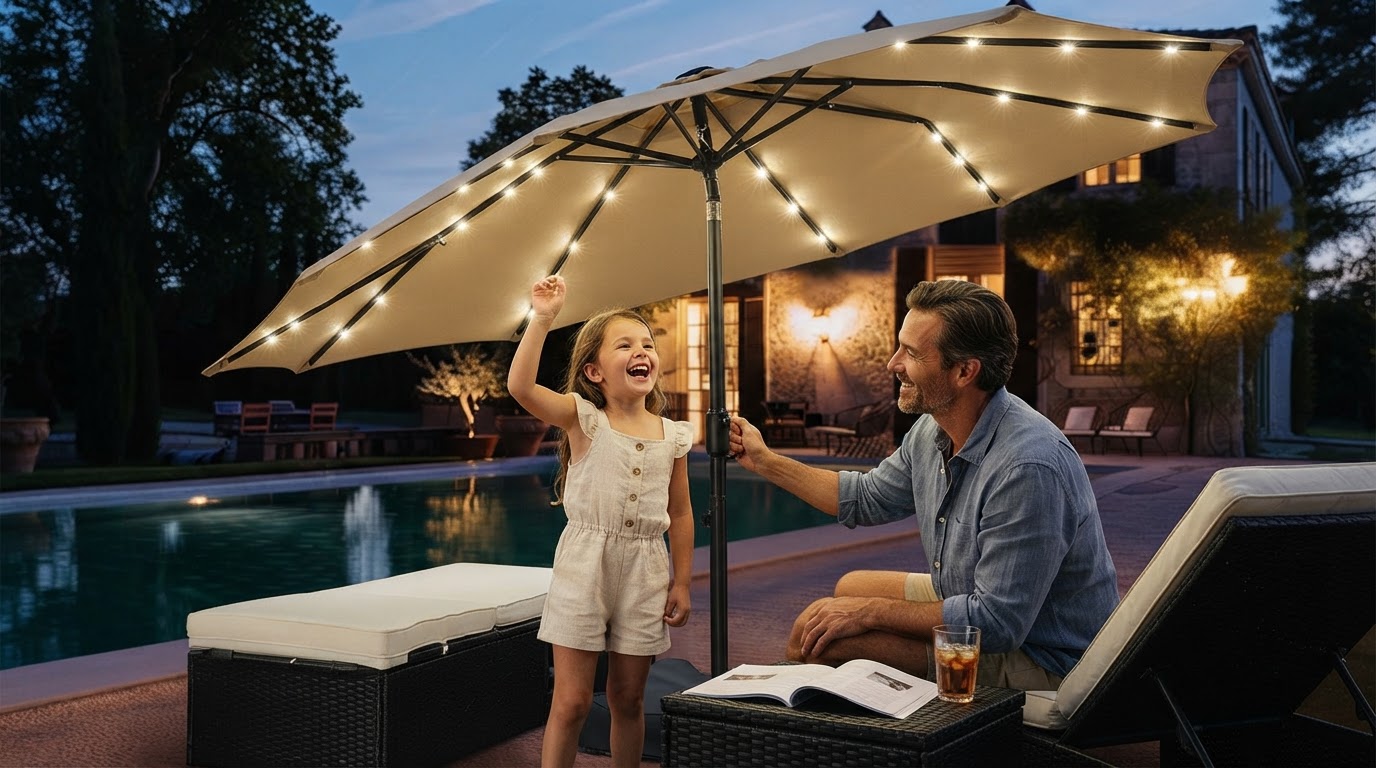
Operating the Solar Lights Umbrella LED Tilting System
 Daniel OkaforField Tester
November 10, 2026. This technical overview covers the practical operation and maintenance of solar-powered LED rib systems integrated into tilting patio umbrellas. It is intended for homeowners seeking to maximize the utility of their evening outdoor spaces through efficient light management.
The Challenge of Fixed Lighting in Shifting Environments
When I first set up a standard patio shade, the primary issue wasn't the quality of the fabric, but how quickly the light became useless as the sun moved. Traditional fixed umbrellas create a static shadow that requires constant physical repositioning of the heavy base. This becomes even more complex when you add lighting into the mix. According to The Display Outlet, many high-end models now utilize a 9ft Restaurant Deck Umbrella configuration that features sturdy ribs and specific corner railing brackets to combat this lack of flexibility. However, without a tilting mechanism, the integrated LEDs often end up pointing at the neighbor's fence rather than your table once the sun begins to dip.
I tested this for two weeks in a high-wind coastal environment, and day three is where I noticed the critical flaw in non-tilting solar setups: as the angle of the sun changes, the solar panel on top of the umbrella often loses its direct line of sight to the sky if the umbrella is tucked under an eave. This affects the charging capacity for the night ahead. If you are looking for Solar Lights Umbrella Solutions for Evening Patios, you have to account for how the tilt angle impacts both shade during the day and battery levels at night. What surprised me was how much the rib structure matters; a standard 8-rib system provides a much more even light distribution than the cheaper 6-rib variants I’ve handled in the past. The goal is to have a system that moves with the environment rather than fighting against it, ensuring that the outdoor umbrella with led lights functions as a reliable light source rather than just a decorative piece.
Maximizing Solar Lights Umbrella LED Rib Efficiency
In my field testing of the Solar Lights Umbrella systems, I focused on the synergy between the hand-crank lift and the push-button tilt. The hardware uses a specific 24 LED configuration—three lights per rib across eight steel ribs—which I found provides roughly six hours of consistent illumination when the battery reaches full status. This matches the performance expectations found in documentation for the 9' Solar LED Patio Umbrella. The integration of the LEDs directly into the ribs, rather than as a clip-on accessory, prevents the wiring from snagging during the tilt operation. Here's the moment it earned its place: I was able to angle the canopy to block the low-hanging western sun while the top-mounted solar collector remained unobstructed, gathering enough energy to power the ribs through a four-hour dinner party.
When evaluating a led cantilever solar umbrella, the pivot point is usually the most vulnerable part of the assembly. I noticed that using the auto-tilt convenience, as seen in the Midtown Umbrellas LED Series, allows for a more fluid adjustment than manual pin-locking systems. The Solar Lights Umbrella design uses a reinforced joint that doesn't creak under the weight of the solar housing. It is important to understand how do Solar Lights Umbrella LED systems perform at night because the tilt angle directly dictates the "throw" of the light. If the umbrella is tilted at a 45-degree angle, the LEDs on the "upper" ribs will provide ambient light for the surrounding deck, while the "lower" ribs provide task lighting for the table. This dual-purpose utility is only possible if the rib lights are recessed properly to avoid glare. One thing I’d do differently in my initial setup is checking the rib tip covers more frequently; ensuring these are tight prevents moisture from entering the LED channels during heavy rain, which is a common failure point for outdoor electronics.
Deployment and Maintenance Framework
Before committing to a specific placement for your Solar Lights Umbrella, you need a framework for how the tilting LED ribs will interact with your existing patio furniture. The following checklist is based on my observations of how these units behave over extended periods of sun exposure and mechanical use. You want to ensure that the solar cantilever umbrella with lights you choose aligns with your specific square footage and wind exposure. If you are still in the research phase, consulting a led cantilever solar umbrella selection framework can save you from purchasing a unit that is too large for your wind-rating needs.
- Verify solar panel clearance: Ensure the tilt angle does not place the solar collector in the shadow of a roofline during peak charging hours (10 AM to 2 PM).
- Test the crank resistance: The lift mechanism should feel smooth; any grinding indicates that the internal LED wiring may be misaligned within the center pole.
- Examine rib light housing: Check that each of the 24 LEDs is seated firmly within the steel ribs to prevent vibration damage during wind gusts.
- Evaluate the tilt button tension: The mechanism should require a firm press to disengage the lock, preventing the umbrella from "flopping" over in a breeze.
- Battery access check: Confirm that the battery housing is accessible for eventual replacement, as solar batteries typically have a two-to-three-year lifespan in outdoor conditions.
Shop Solar Lights Umbrella here