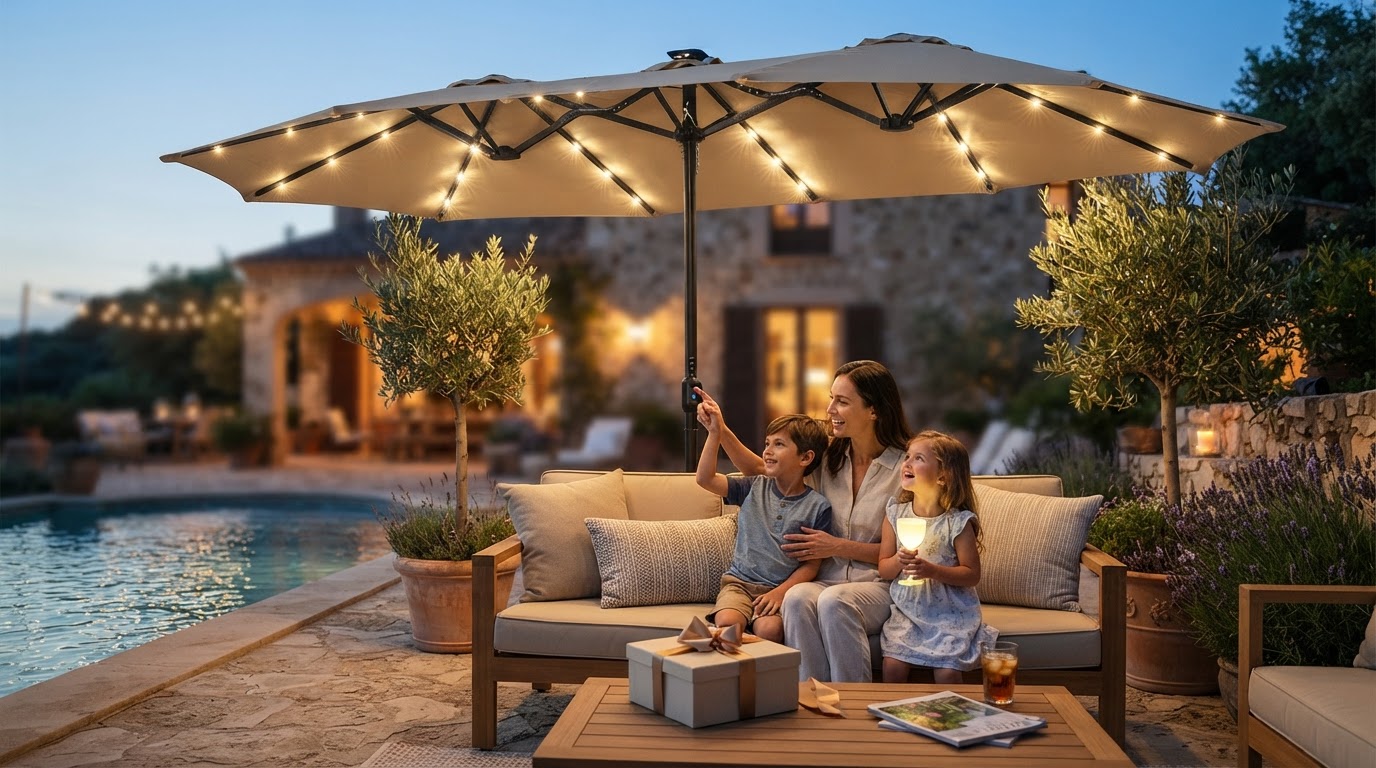
How to operate an outdoor umbrella with LED lights?
 Maya ChenContributing Editor
October 14, 2026 — Operating an outdoor umbrella with LED lights requires a specific sequence of solar panel activation and battery conditioning to ensure the integrated diodes reach their rated lifespan.
Property owners and commercial managers often view these fixtures as simple furniture, but the integration of photovoltaic cells and lithium-ion storage demands a more rigorous maintenance schedule than standard market umbrellas. The conventional wisdom says that you can simply open the canopy and expect light, but the reality involves managing voltage thresholds and panel positioning to avoid premature battery failure.
How does the solar charging system function?
The primary charging cycle for a Solar Lights Umbrella relies on a top-mounted monocrystalline or polycrystalline panel that must remain perpendicular to peak solar radiation for at least six to eight hours. Here's the part nobody talks about: many users fail to realize that the physical power switch located on the rib or pole must often be in the 'off' position during the initial 48-hour conditioning period to allow the battery to reach full capacity without discharge interference. According to technical demonstrations by Yaheetech, standard 9ft solar-powered models typically utilize 32 individual LED lights distributed across the ribs, which draw power from a central hub that requires a clear line of sight to the sun to maintain a consistent 3.7V output.
Run the math: if a panel receives only partial shade for two hours of its peak cycle, the resulting lumen output can drop by as much as 40% during evening operation. While brands like Purple Leaf emphasize the aesthetic value of integrated LEDs, the operational efficiency is strictly governed by the milliamp-hour (mAh) rating of the internal battery. I'll change my mind when manufacturers move away from proprietary Ni-MH cells to standardized, user-replaceable lithium iron phosphate batteries that can handle more frequent deep-discharge cycles without losing 20% of their capacity annually.
What are the lighting configurations for these umbrellas?
Operating the lighting system involves toggling between static ambient modes and, in more advanced units, remote-controlled dimming levels. Unlike the harsh blue-white light found in early iterations, modern LED series umbrellas, such as those cataloged by Midtown Umbrellas, now prioritize a 3K warm white light to provide a luxury glow that mimics incandescent bulbs without the heat signature. This shift in color temperature is not just for aesthetics; lower Kelvin ratings typically result in less attraction for nocturnal insects, which is a critical functional consideration for outdoor dining environments.
Controlling these lights is no longer limited to a manual clicker. Users can now integrate remote control functionality for Solar Lights Umbrella systems to manage zones or brightness levels from a distance. For those utilizing decorative accents, waterproof solar umbrella fairy lights offer a secondary layer of illumination that operates on independent circuits. The reliability of these systems in inclement weather is often questioned, yet weatherproof illumination with Solar Lights Umbrella hardware has become the industry standard for units designed to withstand IP65-rated exposure.
Quick answers
Q: How long do the LED lights stay illuminated on a full charge? A: Most standard models, including those from Yaheetech, provide between 6 to 9 hours of continuous light after a full day of sun exposure. This duration is directly tied to the 32-LED configuration common in 9ft market umbrellas.
Q: Can the LED lights be replaced if a single bulb fails? A: In most integrated rib designs, such as those from Purple Leaf, the LEDs are hardwired into the frame and are not individually replaceable. If a segment fails, it usually requires a replacement of the entire rib assembly or the central wiring harness.
Q: Does the umbrella need to be open for the solar panel to charge? A: No, the solar panel is typically located at the very top of the pole (the finial position), allowing it to charge while the canopy is closed. This is actually preferred during high winds to protect the waterproof solar umbrella fairy lights and internal wiring from mechanical stress.
Q: What is the typical lifespan of the solar battery? A: The internal rechargeable batteries generally last for 500 to 1,000 charge cycles, which equates to roughly 2 to 3 years of regular seasonal use. Performance degradation is usually noticed when the lights begin to dim after only 2 hours of use.
Learn more about Solar Lights Umbrella at https://solarlightsumbrella.com.
Sources
- LED Series Umbrellas
- Lighted Patio Umbrellas | Outdoor Parasols with LED Lights - purple leaf
- LED Lighted - Patio Umbrella Store